
Antibiotics aren't always the answer


Health organisations in Notts are raising awareness about the dangers caused by the overuse of antibiotics as part of a global campaign.
18 – 24 November is World Antimicrobial Resistance (AMR) Awareness Week.
World AMR Awareness Week (WAAW) is a global campaign aimed at improving awareness and understanding of AMR and encouraging everyone to play their part as an Antibiotic Guardian.
In 2019 there were 4.95 million deaths associated with bacterial AMR across 204 countries and the World Health Organisation has identified AMR as one of the most pressing global challenges we face this century.
AMR occurs when the microorganisms which cause disease (including bacteria, viruses, fungi and parasites) are no longer affected by antimicrobial medicines such as antibiotics, antivirals, antifungals and antiparasitics that we use to kill them, prevent and treat the disease.
While resistance is a natural phenomenon and not just a health issue, from a human healthcare perspective it is accelerated by:
- Inappropriate use of antimicrobial drugs.
- Poor infection prevention and control practices.
- A lack of new antimicrobial drugs being developed.
- Insufficient global surveillance of infection rates.
Without effective antibiotics many routine treatments will become increasingly dangerous. Setting broken bones, basic operations, even chemotherapy and animal health all rely on access to antibiotics that work.
How can you make a difference?
NHS Nottingham and Nottinghamshire is highlighting six key steps we can all take to keep antibiotics working:
1. Get vaccinated. It’s really important to get vaccinations when they are offered to you. Vaccines teach your immune system how to create antibodies that protect you from diseases – it’s much safer for your immune system to learn this through vaccination than by catching the diseases and treating them.
2. Wash your hands regularly. Good hand hygiene helps to reduce the spread of infections in the first place.
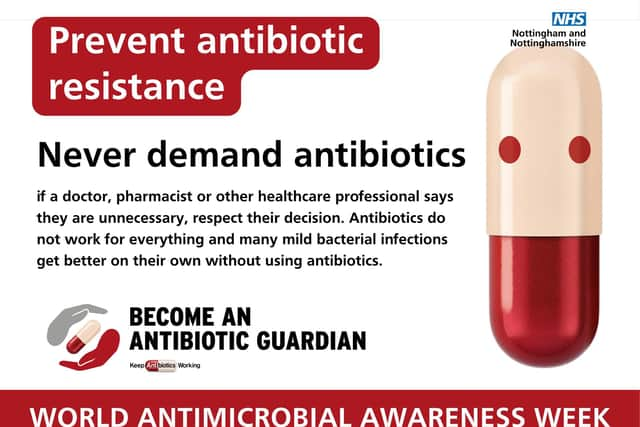
3. Never demand antibiotics. If a doctor, pharmacist or other healthcare professional says they are unnecessary or ineffective, respect their advice. They do not work for everything and many mild bacterial infections get better on their own without using antibiotics.
4. When you are prescribed antibiotics, always take them as instructed. Always take the full course even when you're feeling better – just because symptoms of the illness go away, it doesn’t mean that all of the germs have been killed. Remaining bacteria may cause the illness to start up again. Never share antibiotics prescribed for you with someone else.
5. Return un-opened, un-used or out-of-date medicines to the pharmacy for safe disposal. Putting unused medicines in your general waste or flushing them down the toilet is damaging to the environment and other people – they can adversely affect aquatic ecosystems and lead to the emergence of AMR bacteria. You don’t need to return it to the pharmacy where you originally purchased it and there is no cost to return medication to a pharmacy.
6. Become an antibiotic guardian. Make a pledge at https://antibioticguardian.com/ and share the link with friends and family.
You can hear from patients about the impact of AMR on the NHS Nottingham and Nottinghamshire website: https://notts.icb.nhs.uk/2024/11/15/raising-awareness-about-antimicrobial-resistance/