
Eastwood out of the city but Kimberley in under Nottingham City Council’s LGR proposals
Eastwood would not become part of Nottingham city under proposals set to be put forward by the city council for local government reorganisation (LGR) – but Kimberley and Nuthall both would.
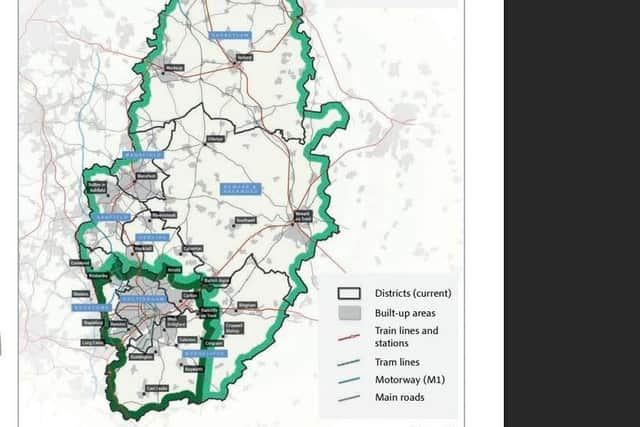
The council has agreed to submit a proposal – known as option bii (2) – to create two new unitary councils, one covering the rural north and east and another for more urban areas in the south and west.

This model would mean the urban centres of Rushcliffe, Gedling and Broxtowe would fall under a new authority, along with the city.
That would see Kimberley and Nuthall joining the new city-based authority, while Eastwood, Giltbrook, Brinsley, Greasley, Bagthorpe, Underwood and Selston would all remain in the new county authority if the proposal were to be accepted.
]The city council’s propsal has the backing of Kimberley MP Alex Norris (Lab) – along with fellow Nottingham Labour MPs Nadia Whittome and Lilian Greenwood.
All nine councils in Nottinghamshire have been drafting plans under the Labour Government’s proposals for LGR, since it was announced last December.
Councils have been debating two options – option 1b and option 1e – but the city council has been pushing for an alternative option that would allow extensions of the city’s boundaries into parts – but not all – of neighbouring boroughs.
And at city council executive board meeting on November 25, senior councillors agreed to put forward option bii as the city’s choice.
Coun Neghat Khan (Lab), council leader, said: “The official city population is 328,000, yet the built-up area houses more than 750,000 people.
"More than 51 per cent of Nottingham’s workforce lives outside the city boundary, they commute into the city, rely on our services, use our infrastructure and contribute to our success, yet have no say in how those services are run.
“We need boundaries that strengthen democratic accountability, support efficient services, and free us from outdated constraints on planning and service delivery.”
Nottingham’s tight boundaries – drawn up back in 1997 – have long been cited as one of the reasons for the council’s financial difficulties, with around 80 per cent of all homes sitting in tax brackets that bring in the least amount of money.
Coun Khan continued: “This option produces a balanced financial profile across both unitary councils.
“Council tax bases are almost identical – 181,328 versus 190,814 band D equivalents.
"This option is by far the fairest and most sustainable model.”
At the moment, council services in Nottinghamshire are delivered under a two-tier structure.
Outside the city, Nottinghamshire County Council runs services such as social care, education, and road maintenance, while district and borough councils are responsible for services such as waste collection and leisure centres.
The city council operates as a unitary authority, providing all council services within the city boundary.
Under LGR, all nine councils would be scrapped and replaced with new unitary councils with a higher population of residents.
The Government says it is hoped this would streamline services, prevent overlap, and save taxpayers’ cash.
The county council and Rushcliffe Council are supporting what’s known as option 1b, under which a Nottingham Council – comprising the city, Broxtowe and Gedling – and a Nottinghamshire Council – serving Ashfield, Bassetlaw, Mansfield, Newark & Sherwood and Rushcliffe – would be created.
Bassetlaw, Newark & Sherwood, Mansfield, and Gedling support the alernative option 1e, under which a Sherwood Forest (north Nottinghamshire) authority – comprising Ashfield, Bassetlaw, Gedling, Mansfield and Newark & Sherwood – and a Nottingham & South Nottinghamshire (south Nottinghamshire) authority – comprising Broxtowe, Nottingham city, and Rushcliffe – would be formed.
All councils must submit their proposals to the Government for review by the end of November.
The Government said it would accept boundary review options, like the one put forward by Nottingham City, where there is ‘strong evidence’ for it.
The decision on which model to implement will be made by the Secretary of State next year, following formal consultation.