
Mansfield Council to spend up to £600,000 on further stabilisation work at quarry landslide site
Mansfield Council needs to spend up to £600,000 on further stabilising works at an old quarry where a major landslide happened six years ago.
On November 7, 2019, the cliff face at Berry Hill collapsed, sending 1,300 tonnes of debris and mud cascading towards residential properties on two cul-de-sacs.
It led to 32 residents being evacuated from their homes.
Urgent repair work was completed within weeks so people could move back in, and after two more landslides in the next two years, permanent stabilisation works took place, starting in the spring of 2021 and finishing in autumn of 2022.
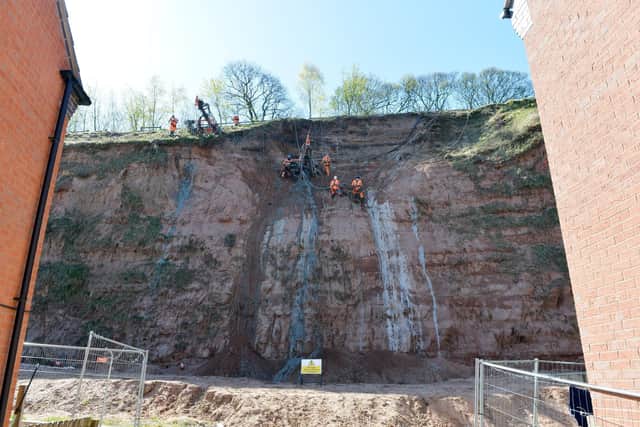

But now, four-and-a-half-years on, geology experts Fairhurst have told the council that more remedial work needs to be completed in a ‘timely manner’ to mitigate further risk.
At a meeting on December 4, council chief executive James Biddlestone awarded the works contract – the value of which has not been disclosed – to an anonymous contractor, which was one of two companies that bid for the chance to complete the work.
Documents say the anticipated maximum cost of the contract is £600,000.
Berry Hill Quarry, on the south side of Mansfield city centre, was a sandstone quarry used for the extraction of sandstone in the second half of the 20th century.
After it closed, a new housing estate was built in its wake, which was completed in 2011.
The streets are looked down on by the cliff faces of the quarry, which back directly onto the back gardens of some of the new homes, on Bank End Close and Stone Bank.
In the week commencing November 4, 2019, heavy rain led to the slope collapsing, sending debris, including dislodged trees, into the gardens of properties across Bank End Close.
No-one was injured at the time.
Immediately, 32 homes were evacuated, with 19 remaining empty for two weeks.
The council put residents in temporary accommodation while they undertook emergency works to clear the material and put temporary protection in place.
Compensation was later provided to residents, and Fairhurst was contracted to complete regular surveys of the cliff face, which continued for two years.
After meetings and an independent investigation by a solicitor was published in July 2020, the council, which owns the land, said it was satisfied that the new estate had been built sensibly and according to planning conditions.
But the solicitor also said that ideally, no development should have been permitted on the site until ‘the stabilisation of the quarry face in both the long and short term had been secured’.
He added: “It is highly questionable as to whether the council should have adopted the cliff top.
“In the event that it did wish to proceed with the adoption of the cliff top it should have taken all reasonable steps to ensure that it fully understood both the financial and legal implications of such an adoption by undertaking the required due diligence.”
Fairhust’s safety surveys repeatedly reported ‘no increased risk’.
However, just nine days after an inspection yielded the same conclusion, in December 2020, another landslip occurred, and some homes had to be evacuated again – although this time, for two nights.
A month later, in January 2021, there was a third landslip, though no homes needed to be evacuated on that occasion.
The permanent works, when they started in March that year, cost £3m and included the installation of mesh netting across the cliff face, secured by pegs, and a ‘catch fence barrier’ at the bottom.
After this was completed, residents’ gardens and fences were finally reinstated along with pathways.
In 2023, the council allocated £1.349m to its budget for the next financial year for what was described as the ‘final phase’ of work, involving the installation of further ‘protective mesh’ between the slope and nearby roads.
However, nearly three years later, it appears that more work remains to be done.
Mr Biddlestone said: “These works are a part of a planned programme of stabilisation works within the quarry, following on from the emergency work that was completed in 2022.
"This next phase of the work is programmed to start towards the end of January and last for around 16 weeks.
“The work required on this phase is not as complex as phase one and is not being done due to any increased risk, but is a part of a programme of stabilisation to better improve the protection and management of the cliff face for the long term.”