
Scrapping of ‘failed experiment’ crime commissioners came ‘as shock’ to Notts office
The Labour Government’s scrapping of police and crime commissioners ‘came as a complete shock’, an official in Nottinghamshire says.
On Thursday, November 13, Home Secretary Shabana Mahmood announced police and crime commissioners (PCCs) would be scrapped – having described them a “failed experiment”.
There are 37 PCCs who are elected by the public under the current system, including Labour’s Gary Godden in Nottinghamshire.
They were introduced just over a decade ago to improve police accountability, with responsibilities ranging from budget setting, appointing a chief constable, and drawing up plans for local policing.

The Home Office says £20m will be reinvested every year before the next election, which will be enough to fund 320 new police officers, while the move will save a total of £100m over the same period.
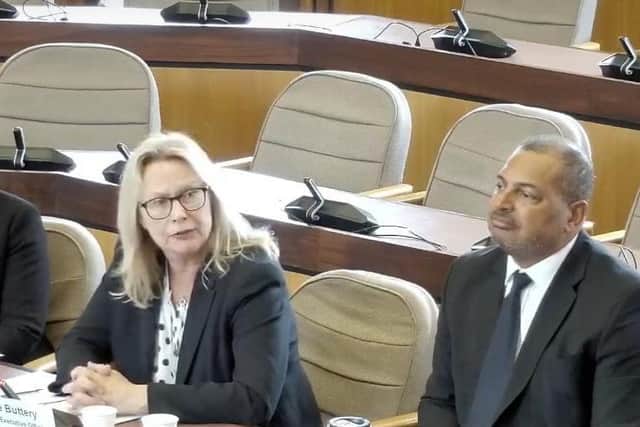
At a Nottinghamshire police and crime panel meeting on Monday, November 17, the chief executive of the Nottinghamshire Office for the Police and Crime Commissioner (OPCC) said the announcement had come as a “complete shock”.
“That was an announcement by the policing minister in a closed meeting with PCCs on Thursday morning at 9.30am,” Michelle Buttery said.
“We were told initially that would become public at 10.10am, when in fact that was announced in Parliament at 12pm.
“But of course this came as a complete shock to PCCs, who were then keen to ensure staff were communicated with extremely urgently so they didn’t hear it first in the media.”
The current commissioners’ terms will come to an end in May 2028 under the plans.
Labour says while PCCs were created to increase accountability, less than 20 percent of voters were actually able to name their locally elected commissioner.
After 2028, Mr Godden’s responsibilities will be transferred to East Midlands Mayor Claire Ward (Lab), and the East Midlands Combined County Authority (EMCCA) that she leads.
“We know there is police landscape reform going on… both police forces and PCCs and equivalents have been part of the national work,” Ms Buttery added.
“We knew that this current Government – as the last – had signalled an intention to look towards devolution as a potential model for police governance, but the particular facts and fact that PCCs were told they would be no more was a complete shock on Thursday.
“So there was feedback as to how the Government had communicated it.”
Christine Goldstraw, independent chair of the panel, added: “I think it came as a surprise to most people.”
The OPCC said talks had already started with Mayor Claire to ensure a smooth transition in 2028.
Ms Buttery added: “For an area like the East Midlands where we do have a mayor in place…there is architecture already in existence to accommodate that change in police governance, and we have communicated with key stakeholders and with the public through the PCC’s media announcement that we will continue as business as usual and we will do our best to lead a smooth transition when it comes in May 2028.
“The change of law required to allow two force areas to come under one mayor is part of the White Paper we are expecting – that will also herald the changes that were announced publicly on Thursday.
“Gary [Godden] has announced he already does have a good relationship with Mayor Claire, and we do as officers with the combined authority, and we also enjoy a good relationship with Derbyshire OPCC.
“So we are in talks very early on. We will continue those talks to ensure a smooth transition when it comes.”