
I took a tour around Newstead Abbey to discover exactly why Lord Byron is still loved to this day

An Englishman’s home is his castle, or so says the well known proverb. If you learn about the castle then you'll learn about the man.
And perhaps such a saying has never rung truer than when you take a look at the iconic 12th Century Newstead Abbey - a mysterious and romantic setting made famous around the globe by its highest-profile owner.
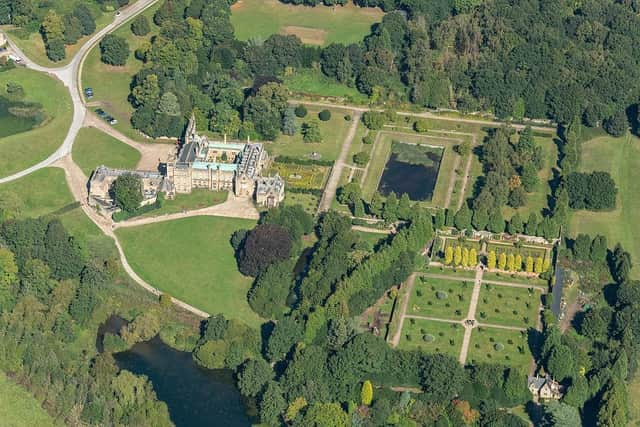

George Gordon, the 6th Lord Byron, has been labelled as one of the greatest romantic poets of his generation - a reputation for magnificence which is also so much in evidence around his former home.
The abbey, nestled just off the A60 in more than 300 acres of picturesque gardens and parkland, began life as a place of holy worship after its creation as an Augustinian priory by Henry II in about 1170.

In 1540, Henry VIII granted Newstead to the poet's ancestor, Sir John Byron, who converted the priory into a house and established his family's connection which still thrives to this day.
Sir John Byron and his successors kept much of the monastic structure and layout so that the house still retains its medieval character, with the eye-catching west front of the church still surviving from the late 13th Century.
But it was thanks to its most inspirational owner that the beautiful abbey was firmly transformed into another place of worship - this time for poetry lovers across the world - and given a legacy which the popular attraction still retains to this very day.
And it was this legacy which I was rather eager to find out much more about when I made my first ever visit to the beautiful abbey for a personal tour around the attraction with my guide, Gillian Crawley.
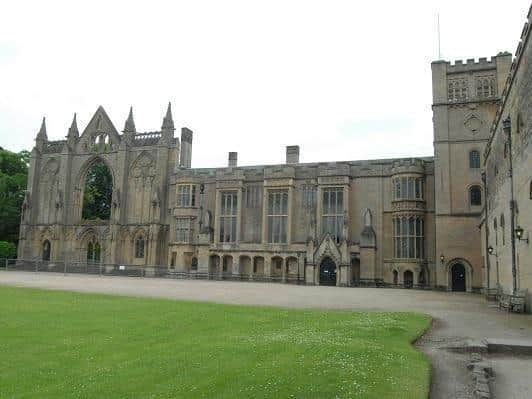
As the sun beat down fiercely and the soothing lakes, ponds and water cascades of Newstead's splendid gardens shimmered delightfully in the glorious sunshine, it was rather easy to understand just why George Gordon, who became the sixth Lord Byron in 1798, found these surroundings so inspiring.
The charming landscape, which owes much of its beauty to the nearby River Leen, includes The Eagle Pond, The Fern Garden, The Spanish Garden and The Japanese Garden, offers the ideal place for quiet, serene and relaxing contemplation capable of getting any poet's creative juices flowing freely.
And it was certainly the case for the revered Lord Byron, who became one of the most popular icons of the Romantic Age, with his personal beauty, brilliant mind and reckless spirit fascinating his contemporaries and poetry lovers for decades to follow.
Like the superhuman heroes of his own dark tales, Byron has often been portrayed as mysterious, self-destructive and proudly defiant. And, for Gillian, the characteristics of the owner sums up his former castle perfectly.
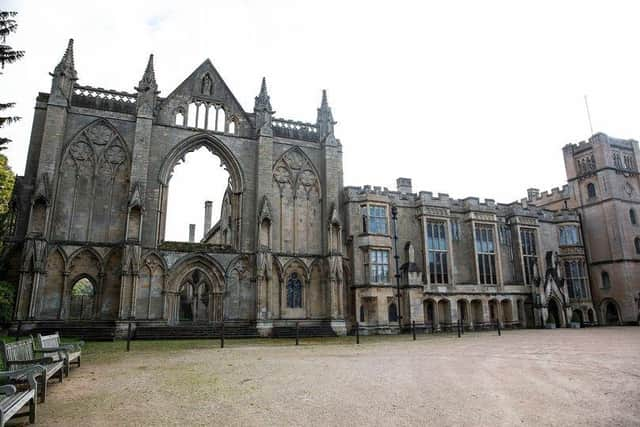
"The abbey shouldn't still be standing after all this time. Why it hasn't been knocked down after the dissolution of the monasteries in 1539 when the abbey was converted into a country house and why it was saved is a mystery," says a rather pleased Gillian.
"But it is certainly for our benefit that it has been saved. The house itself is a great legacy of the fall out from Henry VIII's divorce from Catherine of Aragon and the legacy of Lord Byron and the front of the abbey sets the tone for the whole visit."
"Would Byron still recognise today's surroundings from those where he made his name all those years ago?", I ask Gillian with a touch of curiosity.
"The grounds have not got smaller since Byron's day. There has been a break up of the estate and there are a lot of private properties within the historic bounds, but he would still recognise the modern-day abbey.
"There is gothic romance, there is mystery, there is something unexplained. I think it is a great place to start the visit," gushes Gillian with youthful exuberance and enthusiasm.
And although Byron no longer walks the delightful grounds penning his poetical masterpieces, his inspiration to fellow artists still continues.
"The view is actually very similar to in Byron's day, there is still a lake here, there is still a stable block and the west front and the big bay windows are all still there," said Gillian, whose passion for Lord Byron is evident for all to see.
"The grounds of the abbey are an artist's paradise. Lots of amateur artists come down to paint and the visitors love to see them, but Newstead is synonymous with the poet Lord Byron and it is a place of pilgrimage.
"Byron died a great hero and Newstead became a great place of pilgrimage as a result. People want to come and see where the poet lived and we are in a great shrine I suppose."
As Gillian took me inside the historic abbey house, which Lord Byron called home at various times between the autumn of 1808 and autumn 1814, the evidence of Byron's personal touch instantly leapt out with the contents of his library providing a wonderful and everlasting insight into the mind of the genius.
The impressive library, which Gillian clearly took a great delight in showing off, provides some of the great treasures of Newstead Abbey and includes rare annotated books, letters, furniture and manuscripts belonging to the great poet as well as a variety of cherished personal possessions.
"I have two favourites amongst his possessions in this room," Gillian reveals. "One is the collar to his great dog Boatswain, whom Byron built a shrine to following his death from rabies. He was one of the first Newfoundland dogs brought to Britain, and I think the collar must have been one when he was a puppy because those dogs can get very big.
"The other is a tree trunk that, as a young man, he carved his name into.
"What we have in here are some really fascinating portraits." Gillian then points to a magnificent painting above the fireplace of a remarkably modern-looking Lord Byron, which I was surprised to see would not have looked out of place on a Facebook profile.
"Byron very much controlled his image," explains Gillian. "That romantic poet and that image of striving for your art has never gone away and I think maybe Byron invented that."
And it was in this very room that the gifted Byron shot himself to national fame with a series of poems which captured the heart of a public eager to soak up his impressive work.
Byron embarked on his remarkable career in 1805 and he spent the following three years publishing juvenile poetry, with Fugitive Pieces (printed and withdrawn in November 1806) and Various Occasions (published in January 1807) amongst his early work.
But it was in 1812 that the Cambridge-educated Byron finally enjoyed his big breakthrough, with Childe Harold's Pilgrimage I and II making him instantly famous following its publication on 10th March.
Two years later the demand for Byron was evident for all to see when The Corsair sold a staggering 10,000 copies on the first day of its publication on 1st February 1814.
Yet there was much more to the charismatic Byron than just a major gift for penning poetry, with his desire to stand up for the rights of the downtrodden and poor against the establishment making him an instant hero for the general public.
It was just days before the publishing of The Corsair when the honourable Byron showed he was a man clearly ahead of his time when he delivered the first of just three speeches in the House of Lords opposing the death-penalty for industrial sabotage by starving Nottinghamshire workers.
The poet then stepped back from political life to concentrate on his true love for poetry, producing The Bride of Abydos in 1812, Ode to Napoleon Buonaparte in 1814 as well as Childe Harold III, The Prisoner of Chillon, Darkness, and The Dream in 1816 - just a few notable works amongst his many masterpieces.
However, Byron's scandalous love affairs and shockingly disastrous marriage to Annabella in 1815, which ended with her leaving him just one year later, led to very serious financial difficulties and obliged the poet to leave England in 1816.
He then spent the rest of his brief life in exile on the continent while trying to sell off Newstead Abbey to ease his money woes.