
Eastwood scientist part of international team making major discovery in the Milky Way
A scientist originally from Eastwood is part of an international team that has made new discoveries at the heart of the solar system.
Dr Ashley Barnes is an astronomer at the European Southern Observatory (ESO) — an inter-governmental organisation supported by its member states, including the UK.

The group has just published a major new set of results revealing the central region of the Milky Way in unprecedented detail.
Dr Barnes now lives in Munich but he grew up in Eastwood and still has family living there today.
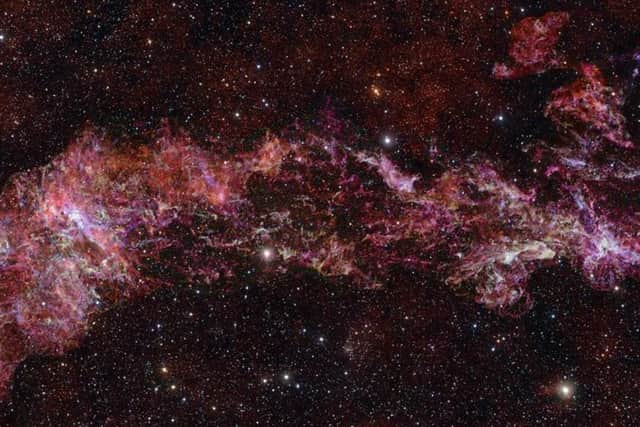
As part of this new project, he and his fellow astronomers have captured the central region of the Milky Way in a striking new image, unveiling a complex network of filaments of cosmic gas in unprecedented detail.
Obtained with the Atacama Large Millimeter/submillimeter Array (ALMA), this rich dataset — the largest ALMA image to date — will allow astronomers to probe the lives of stars in the most extreme region of the galaxy, next to the supermassive black hole at its centre.
Dr Barnes said: “It’s a place of extremes, invisible to our eyes, but now revealed in extraordinary detail.
" The observations provide a unique view of the cold gas — the raw material from which stars form — within the so-called Central Molecular Zone (CMZ) of our galaxy.
"It is the first time the cold gas across this whole region has been explored in such detail.”
The region featured in the new image spans more than 650 light-years.
It harbours dense clouds of gas and dust, surrounding the supermassive black hole at the centre of our galaxy.
Dr Barnes continued: “It is the only galactic nucleus close enough to Earth for us to study in such fine detail.
"The dataset reveals the CMZ like never before, from gas structures dozens of light-years across all the way down to small gas clouds around individual stars.
Prof Steve Longmore from Liverpool John Moores University, another member of the team with Dr Barnes, said: “With ACES, astronomers hope to better understand how these phenomena influence the birth of stars and whether our theories of star formation hold in extreme environments.
“By studying how stars are born in the CMZ, we can also gain a clearer picture of how galaxies grew and evolved.
“We believe the region shares many features with galaxies in the early universe, where stars were forming in chaotic, extreme environments.”
To collect this new dataset, astronomers used ALMA, which is operated by ESO and partners in Chile’s Atacama Desert.
It is the first time such a large area has been scanned with this facility, making this the largest ALMA image ever. Seen in the sky, the mosaic — obtained by stitching together many individual observations like putting puzzle pieces together — is as long as three full moons side-by-side.
Dr Barnes said: “The upcoming ALMA Wideband Sensitivity Upgrade, along with ESO’s Extremely Large Telescope, will soon allow us to push even deeper into this region and explore the interplay between stars, gas and black holes with unprecedented clarity.
“In many ways, this is just the beginning and as someone who grew up in Eastwood, it means a great deal to highlight that people from our area can go on to work on international science projects like this.”