
RSPB: 5 birds you can spot in the UK this September - and where to find them

Summer might be over, but birders shouldn’t pack their binoculars away yet 🐦
- September is a surprisingly good time for birdwatching, according to the RSPB
- Hedgerows are bursting with berries at the moment, attracting many hungry songbirds
- Some reclusive woodland species are easier to spot as they hunt for acorns to store for the cold season
- Arctic and northern European species are also migrating to the UK at the moment to spend the winter
While many would presume spring and summer to be peak birdwatching season, the autumn months have a lot to offer too.
It’s now September, which means autumn is now well and truly here – and many parts of the country have had the weather to prove it this week. But hedgerows across the country are also laden with berries this time of year, a favourite food source for wildlife, and while the British Isles might seem cold to us, they’re positively balmy to birds native to colder climes.
For the casual nature lover, budding photographer, or hobbyist birdwatcher out there, we’ve taken a look at conservation charity the Royal Society for the Protection of Birds’ (RSPB) Nature’s Calendar for September, to see which of the UK’s unique birds it will become easier to spot this month. There are also some rarer visitors making their way over now on their annual migration – although checking them off your year list may require grabbing your binoculars and taking a quick trip.
Here are five of the most exciting species to keep an eye out for this month:
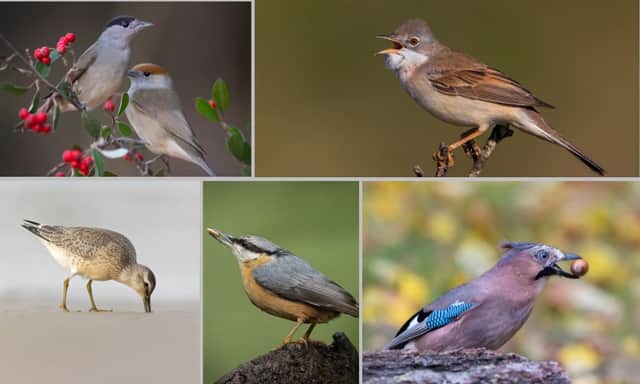

1. Blackcaps
These distinctive warblers used to just be summer visitors from Germany, but more and more of these songbirds can now be found in parks, gardens and woodlands across the UK year-round. They can be identified by their charming little 'hats' – black on grey-toned males and rust-red on the brown females.
The RSPB says that blackcaps are berry lovers, making them much easier to find at this time of year. Scout out any local hedgerows with blackberries, elderberries, hawthorns or rosehips if you’d like to find some.
2. Whitethroats
Whitethroats are also warblers with distinctive songs. These birds usually depart for their overwintering grounds in Africa in September, but as fellow fruit fanatics, they can also be spotted fuelling up in berry-laden hedgerows this month.
These songbirds are fairly beige in colour, although the males have greyer heads, white throat-patches, and a darker brown back. They can be spotted almost anywhere across the UK, except for mountainous or urban city areas.
3. Jays
Possibly the UK’s most colourful corvids, Eurasian jays have buff pinkish feathers with striking black face markings – as well as patches of brilliant blue on their wings. But they’re typically a little shier than their crow and magpie cousins, preferring to take cover in woodland areas, according to the RSPB.
But in September, these birds channel their inner squirrel and start stocking up for winter. They love acorns, and can frequently be seen gathering them up beneath oak trees – or even burying them for later. Jays are year-round residents across most of the country too, with the exception of northern Scotland, and a few parts of North West England.
4. Nuthatches
As their name might suggest, nuthatches will also be hoarding food for the upcoming cold season at the moment. They enjoy a varied diet of hazelnuts, acorns, and various seeds, which they will wedge into holes or spaces in tree bark.
Blue-grey on top and orange below (with “bandit-like” black eye marks), the RSPB says they will even venture into gardens this time of year. Nuthatches can be found around wooded areas throughout Wales, much of England and southern Scotland – but are absent from Northern Ireland.
5. Knots
Those lucky enough to live near mudflats or estuaries are probably familiar with many of the shorebird species that frequent them, like oystercatchers and dunlins. But come September, knots flying south from the Arctic will join them en masse.
These stocky waders fade from ruddy brown to a paler hue over the winter months, but can be spotted foraging near shores in all four UK countries. The Wash, Morecambe Bay, and the Thames, Humber and Dee estuaries are all particularly great places to see them, the RSPB says.
You could potentially even witness them taking flight, in their thousands. A bird migration expert for the charity, Guy Anderson, describes it as a “world class nature spectacle”.
“The number of places you can see that many shore birds in one place together, dancing in the sky in an enormous shoal are very, very few,” he continued. “And we’ve got one of them right here, because of world class mud. No mud, they wouldn’t be there.”
Want to spend more time outside this autumn and help nature from your own backyard? Why not check out some of our other coverage, like this piece on flowers you can plant right now to brighten up your garden – and give wildlife a helping hand.