
How Mansfield Community Diagnostic Centre is leading the way – and how Nottingham’s could look
Same day, same place, that’s how quick and easy it can be to get a diagnosis of something as serious as cancer at Mansfield’s new Community Diagnostic Centre (CDC).
No waiting weeks, no back and forth appointments, no travelling to different places – it can almost all be done here.
It’s a hospital – but only for tests, scans and examinations, away from the chaos of seriously injured patients, screaming babies and sprinting nurses.
There seems to be almost no-one around when we walk into the CDC, as it’s known, at Mansfield Community Hospital – but not in an eerie way.

In the way that everything seems calm and organised – perhaps, ideally, the way a hospital should be.
This building – with its complicated name – is actually very simple.
Community refers to its location – in the community, away from hospitals and ‘closer to where patients actually live and work’, according to Dr James Thomas, Sherwood Forest Hospital Trust’s (SFH) chief medical officer, who played a main role in the creation of this place.
He said: “It’s more accessible, people don’t have to take a whole day off to go and, thirdly, hospitals can be a bit scary, and some people are a bit frightened to go to a hospital for a big test.
"Coming somewhere else might seem a little bit more accessible.”
Diagnostic refers to what goes on here – no A&E, no births, no overnight stays.
Traditionally, to get a diagnosis for a problem, your GP would likely send you to the nearest big hospital site – where you’d potentially have to wait a long time, in a chaotic, noisy and uncomfortable environment.
Here, there’s none of that.
Dr Thomas continued: “What we tried to do is make this not a hospital.
“I think we’ve achieved it, it doesn’t feel busy, the waiting area is empty.
“You can’t see a patient at the moment, because they’re in the room having a test, or they’ve done it.
"We don’t have people hanging around, they come, they have their test at the time that it was timetabled, and they’re gone.”
This is one of more than 150 CDCs that have popped up all over the country in the past five or six years – but it’s the first in Nottinghamshire.
It won’t be for long, though.
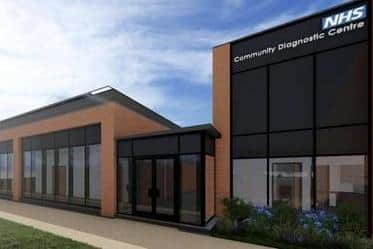
There are well-advanced plans for a CDC at Broadmarsh, right next to the Green Heart, at the bottom end of Nottingham city centre, run by Nottingham University Hospitals NHS Trust.
So how do they work?
And what can we expect from Nottingham’s?
Doctors at GP surgeries can send patients straight to Mansfield’s diagnostic centre to get tested for their problems, instead of going to the hospital.
Let’s say a patient goes to the doctor with shortness of breath, for example.
A GP might sometimes be able to tell what the problem is themselves.
But if they can’t – maybe they’re uncertain whether it’s a lung problem or a heart problem – they’ll send them to the CDC.
Before, a GP would have to guess which they think it is, and refer them to the appropriate hospital’s department for tests, without being certain it’s the right place for them.
At Mansfield’s CDC, the patient will have a CT scan to see how their lungs look, then a function test in the respiratory corridor, where their breathing and lung volume will be measured.
If they need anything else, like a blood test, they can also get that here, as well as see a consultant.
The best bit is that they can then wait in the corridor to get their results on the same day.
Traditionally, their CT scan, lung function test, blood test and results would all be separate appointments.
Carl Miller, clinical deployment lead at SFH, said: “Almost all of those patients will get a diagnosis on the day.
“The consultant will send a letter to the GP and say ‘this is what we’ve found, this is what we need to do, carry on with the treatment and refer back to us if things change’.”
Lung problems can be diagnosed in as little as three hours.
Amanda said: “The CDC reduces what we call care miles, too.
“Reducing the number of journeys a patient takes means there’s less carbon on the roads as well.
"It’s all-rounded – it benefits patients, early diagnosis, and it’s good for the environment.”
Blood testing is often a key part of medical diagnosis, so there’s a dedicated room for it at the CDC.
But patients who need their bloods taken for any reason can also be sent there, away from the hustle and bustle of the hospital.
Sally Thompson, phlebotomist, said: “I think for some patients, especially when they’re vulnerable or not feeling particularly well, Kings Mill (in Sutton) is so fast-paced, so hectic and so busy.
“This is a much calmer environment for patients to come into, it’s a lot better.”
Patients who have a blood test booked don’t even need to sign in at reception – they just look for the red and orange blood-test colour-coded chairs, sit down and wait for the phlebotomist to call their name.
Emma Chapman, fellow phlebotomist, added: “You haven’t got the waiting list of the doctors.
“A lot of patients can panic when they’re told they need a blood test as they think there’s got to be something wrong.
“But then they can’t get a blood test at the GP for five weeks.
"The relief is they can just book on the day here, it relieves a lot of stress.”
The MRI room at the CDC benefits from a new technology called ‘ambient experience’ – the projection of relaxing atmospheric videos onto the back wall of the room, which the patient can see through a mirror above them.
The patient can choose from a range of imagery such as ocean and forest scenes, designed for relaxation, especially if they’re claustrophobic.
Claire Barnes, lead radiographer, said: “We’ve had massive success with this.
“Patients that are extremely claustrophobic and can’t manage any other scanner, we bring them here and they’ve managed it and all said how they think they feel more at ease.
“The building is light and airy, there’s less time pressure, it has been a godsend for us and our patients absolutely love it.
"We’re getting patients who’ve been here wanting to come back.”
CT scans also happen at site as part the plan to move as much of the outpatient stuff from Kings Mill down here’ as Carl puts it.
Another service provided at the CDC is endoscopies, with two separate corridor routes for men and women, consisting of changing rooms, waiting rooms and examination rooms.
Patients whose endoscopies show something abnormal can be taken straight for a CT scan, just a few seconds’ walk away.
In a traditional hospital, they’d probably be sent home and have to wait for a further scan, increasing anxiety.
As well as a whole other department for ultrasound scans – the type used for pregnancies – there are also rooms here which other local services, such as sexual health or dermatology, for example, can use.
They’d usually run their services elsewhere, and still do, but they can use the CDC on occasion to ease pressure.
Dr Thomas says that the opening of Mansfield’s CDC has been a resounding success.
He said: “It’s been stunning, we’re now almost at 100 per cent capacity of what we predicted to be.
WThe staff love it and the patients love it, it’s working like a dream.”
Nottingham’s CDC is set to open in less than a year’s time, with spring 2027 the target.
Dr Thomas, Carl and Amanda are all in close contact with the people leading the Nottingham project, to give them tips, dos and don’ts in terms of running a CDC.
And after Nottingham’s opens next year, healthcare bosses could look even further in the county.
Carl said: “I think an interesting question really is whether Nottinghamshire needs a third or a fourth CDC.
"That’s a question we are actively asking of ourselves.
“There are benefits – huge benefits.
"Can we capitalise on those benefits in other places and areas – I think we probably can.”